Last updated: September 2026 | Reviewed by Fran A., Founder & Editor-in-Chief
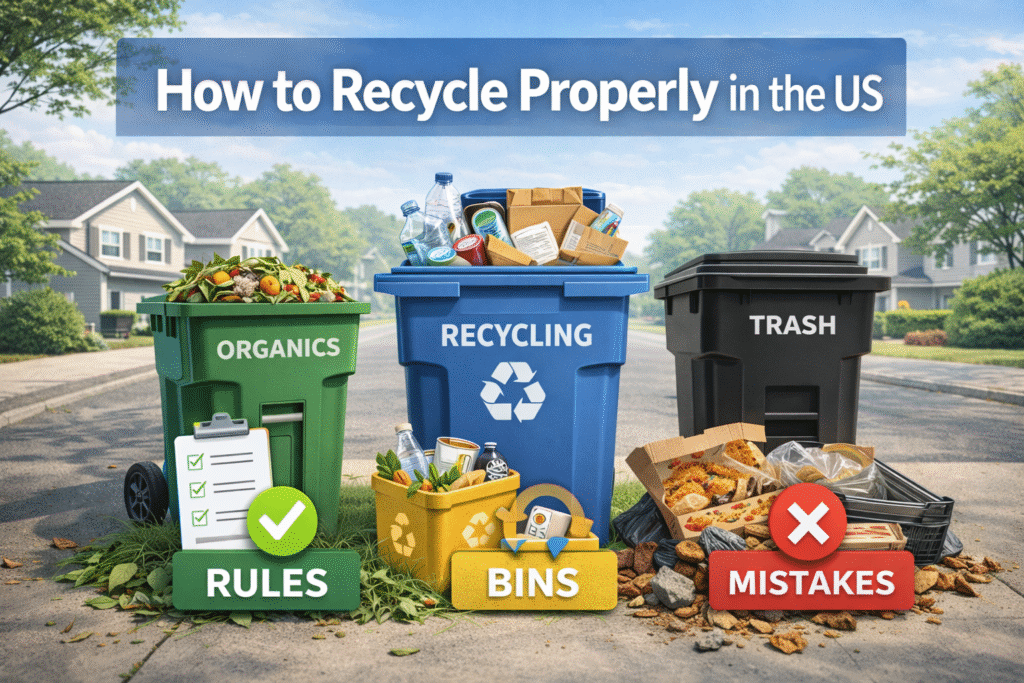
Standing over the blue bin holding a yogurt cup, a pizza box, or a plastic bag and wondering whether it belongs there? You’re not alone. It’s the most common recycling question in America — and the honest answer is that it depends on your city.
But the core rules are remarkably consistent across the country. This guide explains what goes in recycling bin USA programs almost always accept, what they almost never accept, the gray-area items that vary by city, and how to check your own local rules in under a minute.
⚠️ Quick Answer
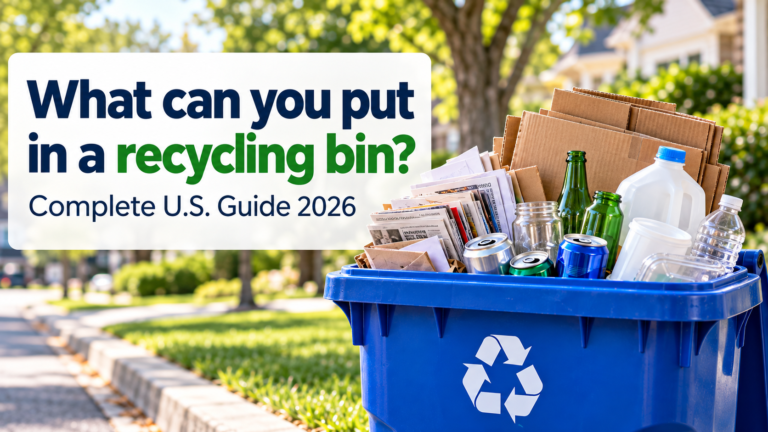
Almost always accepted in U.S. curbside recycling:
- Cardboard boxes (flattened) and paperboard
- Paper: newspaper, mail, office paper, magazines
- Plastic bottles and jugs (#1 and #2)
- Aluminum and steel cans
Almost never accepted:
- Plastic bags and film
- Styrofoam / polystyrene foam
- Batteries and electronics
- Food and liquids
- Hoses, cords, and string lights
Varies by city — always check locally:
- Glass, plastics #3–#7, cartons, pizza boxes, shredded paper
Golden rule: Empty, clean, dry, and loose. When in doubt, throw it out.
Why Recycling Rules Differ From City to City
There is no national recycling law in the United States. Every city or county decides what its program accepts, based mainly on two things:
1. The sorting facility it uses. Your recyclables go to a Materials Recovery Facility (MRF), where machines and workers separate them by material. Each facility has different equipment, and some materials can’t be sorted at certain facilities.
2. Whether there’s a buyer. Recycling only works if someone buys the sorted material to make new products. Since China’s 2018 “National Sword” policy sharply restricted imports of contaminated recyclables, many U.S. programs tightened their rules and dropped low-value materials.
That’s why a plastic tub accepted in one city may be rejected 20 miles away. The categories below reflect the most common U.S. practice — your local program always has the final word.
What Goes in Recycling Bin USA Programs Accept – The Universal List
These items are accepted in the vast majority of U.S. curbside programs.
Paper and Cardboard
| Item | Accepted? | Tip |
|---|---|---|
| Cardboard shipping boxes | ✅ Yes | Flatten completely; remove excess tape if easy |
| Paperboard (cereal, cracker, tissue boxes) | ✅ Yes | Remove plastic liners |
| Newspapers and inserts | ✅ Yes | Keep dry |
| Junk mail and envelopes | ✅ Yes | Window envelopes are usually fine |
| Office and printer paper | ✅ Yes | Staples and paper clips are usually fine |
| Magazines and catalogs | ✅ Yes | Glossy paper is recyclable |
| Paper bags | ✅ Yes | Can also be used to hold shredded paper where allowed |
| Toilet paper and paper towel rolls | ✅ Yes | Cardboard tubes only |
Keep paper dry. Wet paper fibers are weaker and often can’t be recycled. If rain is expected, make sure your bin lid closes fully.
👉 Related: Cardboard Recycling Day Near Me – How to Prepare & Schedule
Plastics (Bottles, Jugs, and Tubs)
| Item | Accepted? | Tip |
|---|---|---|
| Water and soda bottles (#1 PET) | ✅ Yes | Empty; most programs now ask you to leave caps on |
| Milk and juice jugs (#2 HDPE) | ✅ Yes | Rinse quickly |
| Detergent and shampoo bottles (#2) | ✅ Yes | Empty completely |
| Yogurt and margarine tubs (#5 PP) | ⚠️ Often | Accepted in many — not all — programs |
| Clamshell containers (berries, salads) | ⚠️ Varies | Many programs reject them even when labeled #1 |
👉 Related: Plastic Recycling Numbers Explained: What’s Accepted Curbside?
Metals
| Item | Accepted? | Tip |
|---|---|---|
| Aluminum soda and beer cans | ✅ Yes | Don’t crush if your program asks you not to (some sorters need the shape) |
| Steel and tin food cans | ✅ Yes | Rinse; lids can go inside the can |
| Empty aerosol cans | ⚠️ Often | Must be completely empty — never puncture |
| Clean aluminum foil and pie tins | ⚠️ Often | Ball foil into a fist-sized ball |
What Never Goes in the Recycling Bin
These items cause the most damage at recycling facilities. Keep them out of your blue bin everywhere in the U.S.
Plastic Bags and Film
Grocery bags, bread bags, bubble wrap, and plastic wrap are the #1 contaminant in curbside recycling. They wrap around the rotating screens at sorting facilities, forcing workers to stop the line and cut them free by hand.
What to do instead: Many grocery and big-box stores have plastic bag drop-off bins near the entrance. Check before you go — not every store participates.
And don’t bag your recyclables. In most single-stream programs, recyclables tied inside a plastic bag go straight to landfill because workers can’t open them. (A few cities, such as New York City, have their own rules about clear bags — check your local program.)
Batteries (Especially Lithium-Ion)
Lithium-ion batteries — found in phones, laptops, vapes, power tools, and toys — can ignite when crushed in a truck or sorting facility. Battery fires at recycling plants are a serious and growing safety problem.
What to do instead: Take batteries to a battery drop-off (many hardware and electronics stores offer one) or a household hazardous waste site.
👉 Related: Battery Recycling Pickup Day – How to Dispose Safely
Electronics
TVs, computers, phones, chargers, and cords don’t belong in curbside recycling, and many states prohibit putting certain electronics in the trash at all.
👉 Related: Electronics Recycling Pickup – E-Waste Drop-Off by City
“Tanglers”
Garden hoses, extension cords, Christmas lights, rope, chains, and wire hangers wrap around sorting equipment the same way plastic bags do.
Styrofoam and Polystyrene Foam (#6)
Foam cups, takeout containers, egg cartons, and packing peanuts are rarely accepted curbside. Some areas have dedicated foam drop-off sites.
Food, Liquids, and Heavily Soiled Items
Leftover food and liquid contaminate paper and cardboard, making them unrecyclable. Empty every container. If your city has a composting or green bin program, food scraps go there.
Hazardous Items
Never put these in any curbside bin:
- Propane tanks and gas cylinders (explosion risk)
- Needles and medical sharps (injury risk for workers)
- Paint, chemicals, and motor oil
- Anything that contained a hazardous product and isn’t completely empty
👉 Related: Hazardous Waste Pickup Day Near Me – 2026 Schedule
Other Common Mistakes
- Clothing, shoes, and textiles → donate or use a textile drop-off
- Diapers → trash
- Receipts (shiny thermal paper) → trash
- Pots, pans, and scrap metal → usually not curbside; try a scrap metal recycler
- Ceramics, mirrors, window glass, and drinking glasses → trash (different composition from bottle glass)
- Small loose items under about 2 inches (loose caps, bits of foil) → too small to sort; they fall through the machinery
Gray-Area Items – Check Your City’s Rules
These items are accepted in some U.S. programs and rejected in others. This is where most confusion happens.
| Item | Why It Varies | What to Do |
|---|---|---|
| Glass bottles and jars | Glass breaks in trucks and contaminates paper; some cities have moved glass to drop-off only | Check if your city accepts glass curbside |
| Plastics #3, #4, #6, #7 | Few buyers exist for these materials | Assume no unless your city lists them |
| Milk and juice cartons | Require specialized processing | Accepted in many programs — check locally |
| Pizza boxes | Grease can contaminate paper fibers | Many programs now accept them if food is removed; tear off heavily soaked parts |
| Shredded paper | Pieces are too small for most sorting screens | Some cities accept it in a sealed paper bag; others say compost or trash |
| Paper coffee cups | Most have a thin plastic lining | Usually trash — check locally |
| Frozen food boxes | Often coated to resist moisture | Varies by program |
| Aerosol cans | Must be fully empty | Accepted in many programs when empty |
👉 Related: Glass Recycling Pickup Schedule – Does Your City Accept Glass?
What Do the Recycling Numbers Mean?
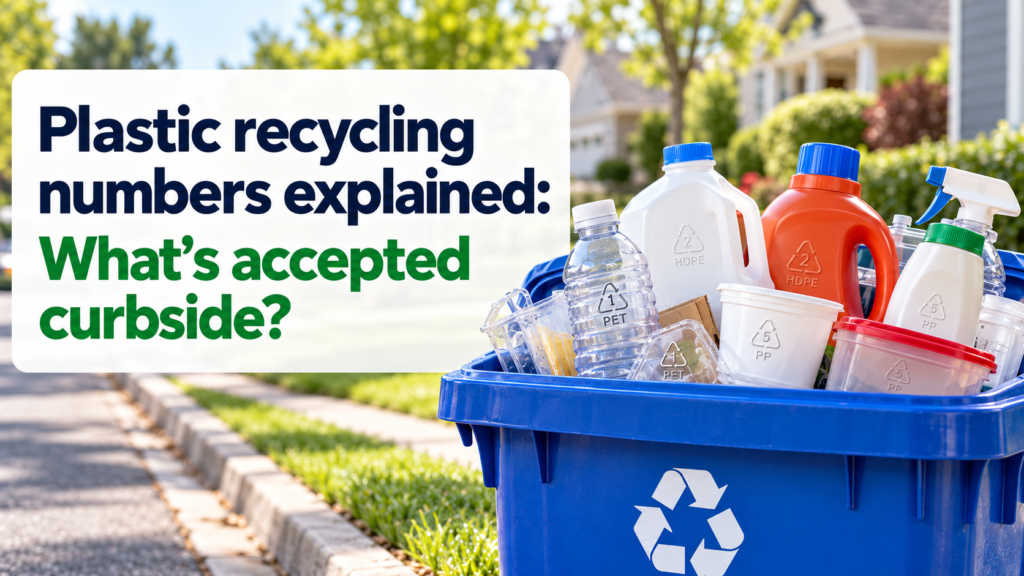
The number inside the triangle on plastic packaging is a resin identification code. It tells you what type of plastic the item is made of — it does not mean the item is recyclable in your city.
| Code | Plastic Type | Common Items | Curbside Acceptance |
|---|---|---|---|
| #1 PET | Polyethylene terephthalate | Water and soda bottles | ✅ Widely accepted |
| #2 HDPE | High-density polyethylene | Milk jugs, detergent bottles | ✅ Widely accepted |
| #3 PVC | Polyvinyl chloride | Pipes, some clear packaging | ❌ Rarely accepted |
| #4 LDPE | Low-density polyethylene | Plastic bags, squeeze bottles | ❌ Rarely accepted curbside (bags → store drop-off) |
| #5 PP | Polypropylene | Yogurt tubs, bottle caps | ⚠️ Accepted in many programs |
| #6 PS | Polystyrene | Foam cups, takeout containers | ❌ Rarely accepted |
| #7 Other | Mixed or other plastics | Some bottles, compostable plastics | ❌ Rarely accepted |
Shape matters too. Many programs accept plastic bottles, jugs, and tubs but not other shapes with the same number. Check whether your city’s list goes by number, by shape, or both.
👉 Related: Plastic Recycling Numbers Explained: What’s Accepted Curbside?
How to Prepare Your Recyclables – 5 Rules
1. Empty it. No food, liquid, or product left inside.
2. Give it a quick rinse. It doesn’t need to be spotless — a quick swish of water is enough. Don’t waste lots of water.
3. Keep it dry. Especially paper and cardboard.
4. Keep it loose. Don’t bag recyclables unless your city specifically instructs you to.
5. Flatten cardboard. Flat boxes leave room for more material and help your lid close — an open lid is one of the most common reasons bins get skipped.
👉 Related: How to Sort Trash for Recycling: A Visual City-by-City Guide
Why “Wishcycling” Hurts Recycling
“Wishcycling” means putting something in the recycling bin hoping it can be recycled. It feels harmless, but it causes real problems:
- It contaminates good material. Food, liquids, and wrong items can ruin otherwise recyclable paper and cardboard.
- It damages equipment. Bags and tanglers jam machinery; batteries can start fires.
- It raises costs. Contaminated loads cost more to process and are harder to sell — costs that often come back to residents through fees.
- It can get your bin rejected. In some cities, crews tag or skip visibly contaminated bins.
👉 Related: Why Was My Trash Not Picked Up? 7 Common Reasons
The simple fix: When in doubt, throw it out — or look it up.
Single-Stream vs. Dual-Stream Recycling
Most U.S. cities use single-stream recycling: all accepted recyclables go into one bin, and the sorting facility separates them.
Some cities use dual-stream recycling, where you separate materials yourself. New York City, for example, separates paper and cardboard from metal, glass, and plastic.
Knowing which system your city uses matters: in a dual-stream city, mixing paper with bottles can get your recycling rejected.
👉 Related: Single-Stream Recycling vs Sorted Recycling: What’s Your City?
Bottle Deposit States – Get Money Back for Containers
Ten U.S. states have container deposit laws (“bottle bills”): California, Connecticut, Hawaii, Iowa, Maine, Massachusetts, Michigan, New York, Oregon, and Vermont.
In these states, you pay a small deposit — typically 5 to 10 cents per eligible container — when you buy certain beverages. You get it back when you return the container to a redemption center or participating store.
Which containers qualify varies by state. If you live in one of these states, returning eligible bottles and cans can be better than putting them in your curbside bin: you get your deposit back, and deposit programs tend to produce cleaner, higher-value material.
How to Check Your City’s Recycling Rules
Because every program is different, a one-minute check is always worth it.
Method 1 – Your city’s sanitation website. Search “[your city] what goes in recycling.” Most cities publish an accepted materials list or printable flyer.
Method 2 – Your hauler’s website. If a private company handles your collection (Republic Services, WM, Recology, and others), they publish accepted materials by service area.
Method 3 – A recycling app. Many cities partner with apps that let you search a specific item and get your local answer.
👉 Related: Best Recycling Apps for U.S. Residents – Find Pickup Days Fast
Method 4 – Call 311. Most large cities can answer “can I recycle this?” questions by phone.
Method 5 – Look for the How2Recycle label. Many products now carry a How2Recycle label that tells you how to prepare the package and whether it’s widely accepted.
City Recycling Guides
- Trash Pickup Schedule in New York City, NY – 2026 Guide
- Los Angeles Trash Collection Calendar 2026
- Philadelphia Garbage Collection Days 2026
- Las Vegas Solid Waste Pickup Schedule 2026
Frequently Asked Questions
What can you put in a recycling bin in the USA?
Almost every U.S. curbside program accepts flattened cardboard, paperboard, paper, plastic bottles and jugs (#1 and #2), and aluminum and steel cans. Glass, cartons, and other plastics vary by city. Items should be empty, clean, dry, and loose.
Do I need to rinse recyclables?
A quick rinse is enough. The goal is to remove food and liquid so they don’t contaminate paper and cardboard — containers don’t need to be spotless.
Should I leave caps on plastic bottles?
Many U.S. programs now ask you to leave caps screwed onto empty bottles, since loose caps are too small to sort. Some programs still ask you to remove them, so check your local rules.
Can pizza boxes go in the recycling bin?
Often yes, if all food is removed. Many programs accept pizza boxes with light grease stains; tear off and throw away parts that are heavily soaked or have cheese stuck to them. Some cities still say no — check locally.
Can I recycle plastic bags curbside?
Almost never. Plastic bags jam sorting machines. Take clean, dry bags to a store drop-off bin if one is available near you, and don’t bag your recyclables unless your city says to.
Is glass recyclable curbside?
It depends on your city. Many programs accept glass bottles and jars, but some have moved glass to drop-off only. Drinking glasses, mirrors, and window glass are never accepted in bottle-glass recycling.
What does the number on plastic mean?
It’s a resin identification code showing the type of plastic. It does not mean the item is recyclable. In most U.S. programs, #1 and #2 bottles and jugs are accepted; #5 is accepted in many; #3, #4, #6, and #7 are rarely accepted curbside.
What happens if I put the wrong thing in the recycling bin?
Wrong items can contaminate good material, jam machinery, or start fires (batteries). In some cities, visibly contaminated bins are tagged or left uncollected.
How often is recycling picked up?
It depends on your city — some collect weekly, others every other week. 👉 Is Trash Pickup Every Week or Every Two Weeks?
Related Recycling Guides
- Plastic Recycling Numbers Explained: What’s Accepted Curbside?
- Cardboard Recycling Day Near Me – How to Prepare & Schedule
- How to Sort Trash for Recycling: A Visual City-by-City Guide
- Single-Stream Recycling vs Sorted Recycling: What’s Your City?
- Glass Recycling Pickup Schedule – Does Your City Accept Glass?
- Best Recycling Apps for U.S. Residents
- Complete U.S. Trash Pickup Guide 2026 – Everything You Need to Know
This guide reflects common U.S. curbside recycling practice as of September 2026. Accepted materials vary by city and hauler — always confirm with your local program. If you notice an error, contact us and we’ll review it within 48 hours.
Written and maintained by Fran A., Founder & Editor-in-Chief — trashpickupscheduleday.com