
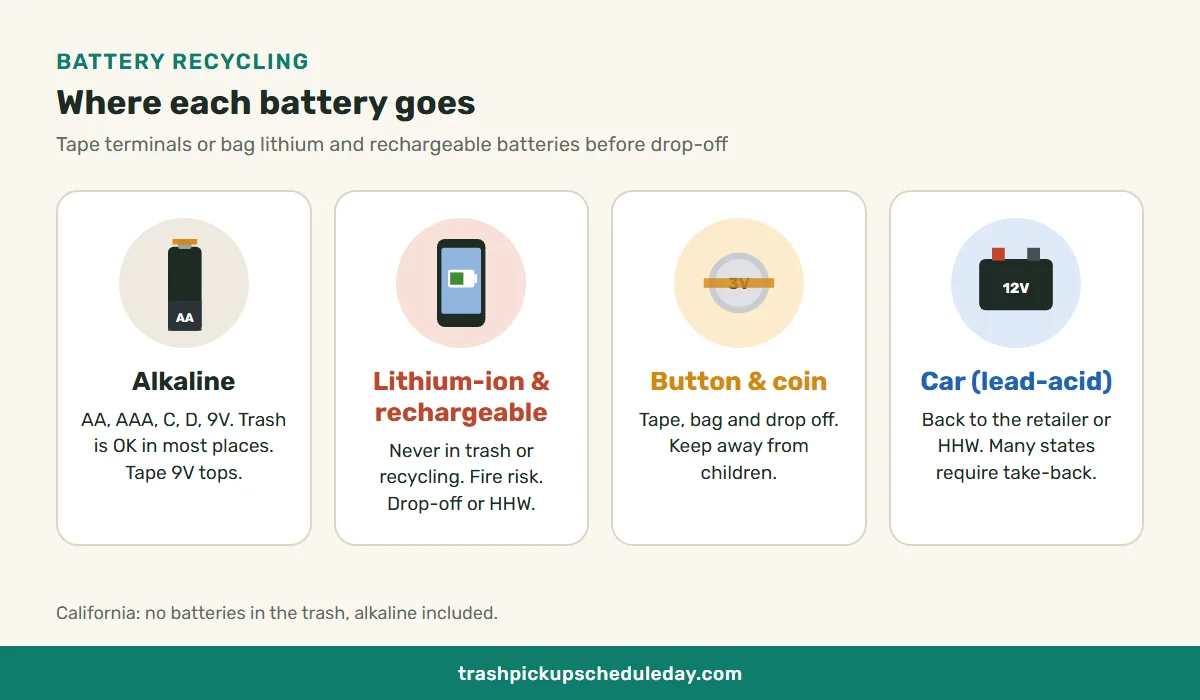
Battery recycling depends entirely on the kind of battery. Ordinary alkaline batteries (AA, AAA, C, D, 9-volt) can go in the household trash in most of the U.S. Lithium-ion, rechargeable, button/coin and car batteries should never go in the trash or your curbside recycling bin. They belong at a battery drop-off point, a participating store or a household hazardous waste program.
Curbside battery pickup is rare. In most cities, “battery recycling day” means a drop-off box or a hazardous waste collection event. Below: what to do with each type, how to prepare batteries so they don’t start fires, and how to find a drop-off near you.
Why batteries don’t go in the recycling bin
Almost no curbside program accepts batteries loose in the recycling cart. They’re the wrong material for sorting machines and, in the case of lithium batteries, a fire risk. When a lithium-ion battery is crushed in a garbage truck or a sorting facility, it can short-circuit and ignite. The EPA states plainly that lithium-ion batteries and devices containing them should not go in household garbage or recycling bins, and says they should go to separate recycling or household hazardous waste collection points.
That applies to the battery inside a device too: phones, laptops, vapes, power banks, electric toothbrushes, cordless tools and kids’ toys.
What to do with each type of battery
| Battery type | Where you’ll find it | Trash? | Where it goes |
|---|---|---|---|
| Alkaline, zinc-carbon (AA, AAA, C, D, 9V) | Remotes, flashlights, clocks | Allowed in most communities, but not in California | Trash where allowed, or a battery drop-off |
| Lithium-ion (rechargeable) | Phones, laptops, power banks, tools, e-bikes | No | Battery drop-off, participating retailer or HHW |
| Nickel-cadmium, nickel-metal hydride (rechargeable) | Rechargeable AAs, older cordless tools | No | Battery drop-off, participating retailer or HHW |
| Lithium single-use, button and coin cells | Watches, key fobs, cameras, smoke detectors | No | Battery drop-off or HHW |
| Lead-acid | Cars, motorcycles, lawn tractors | No | Back to the retailer, or HHW |
Alkaline batteries
Most single-use AA, AAA, C, D and 9-volt batteries are alkaline. The EPA says that in most communities, alkaline and zinc-carbon batteries can be safely put in household trash, though it still recommends recycling them where possible. Two exceptions matter:
- California treats all batteries, alkaline included, as universal waste, and they can’t go in household trash.
- Some cities ask for a precaution. Philadelphia, for example, accepts non-rechargeable batteries with trash but asks residents to wrap tape around both ends.
9-volt batteries deserve the tape no matter what: both terminals sit on top, and touching a key or another battery can make them spark.
Rechargeable and lithium-ion batteries
These are the ones to take seriously. Before you drop them off:
- Tape the terminals with clear packing or electrical tape, or put each battery in its own plastic bag. The EPA recommends either.
- Don’t remove a battery that isn’t designed to come out. Take the whole device to an electronics or battery drop-off instead.
- Set aside swollen, damaged or hot batteries. Put them in a bag on a non-flammable surface and call your local hazardous waste program for instructions. Don’t put them in a store collection box.
Many hardware and electronics stores have free collection boxes for rechargeable batteries. The largest U.S. program, long known as Call2Recycle and now renamed The Battery Network, runs a drop-off locator you can search by ZIP code. Several states and Washington, DC have battery recycling laws that fund collection. The Battery Network lists Connecticut, Illinois, Nebraska, New York, Vermont, Washington and Wisconsin among them.
Button and coin batteries
The EPA says not to put button-cell, coin or single-use lithium batteries in the trash or municipal recycling. Tape them (around the whole button works), bag them and take them to a battery drop-off. At home, keep them well away from small children. Swallowed coin batteries cause serious internal burns.
Car and other lead-acid batteries
A car battery holds lead and sulfuric acid. The EPA says to return it to the battery retailer or to your local household hazardous waste program. When you buy a new car battery, many states require the store to take the old one back, and many add a refundable core charge if you don’t return one. Keep the old battery upright, capped and undamaged on the way to the store.
Battery recycling drop-offs near you
- Retail collection boxes: home improvement, office supply and electronics stores often take rechargeables and sometimes single-use batteries. Check the locator or call first.
- Your city’s drop-off centers: Philadelphia, for instance, takes lithium, rechargeable and lead-acid batteries in battery containers at its sanitation convenience centers.
- Household hazardous waste programs: permanent county facilities or seasonal collection days usually accept every battery type.
- Electronics recycling events: good for devices with built-in batteries. See our guide to electronics recycling pickup.
A simple system at home
Keep a small, non-metal container with a lid in a cool, dry place, away from flammable materials. Tape each battery as it goes in. When it’s full, take it with your other drop-off items, such as leftover paint or old electronics, in one trip. And when something isn’t picked up from the curb, a stray battery or hazardous item in the bin is a common reason. See why trash isn’t picked up.
Pingback: Electronics Recycling Pickup Near Me – E-Waste Drop-Off Guide 2026
Pingback: Los Angeles Trash Pickup Schedule 2026 | LA Sanitation Days
Pingback: Household Hazardous Waste Pickup Day: Find Drop-Off Near You
Pingback: Paint Disposal Near Me: Free Drop-Off, Latex and Oil-Based Rules
Pingback: What Goes in Recycling Bin USA? Complete Curbside Guide 2026
Pingback: Bulk Pickup Examples: What Items Are Usually Accepted - Trash Pickup Schedule Day