To set up trash service at a new home, first find out who collects trash at that address. It might be the city, a private hauler contracted by the city, a company you hire yourself, or your landlord or HOA. That decides everything else: whether service starts automatically with your water account, whether you have to sign up and pay a hauler, and who brings the carts.
This guide follows the order things actually happen in a move, with examples from cities that publish their process, plus the first-week mistakes that get new residents’ bins skipped.
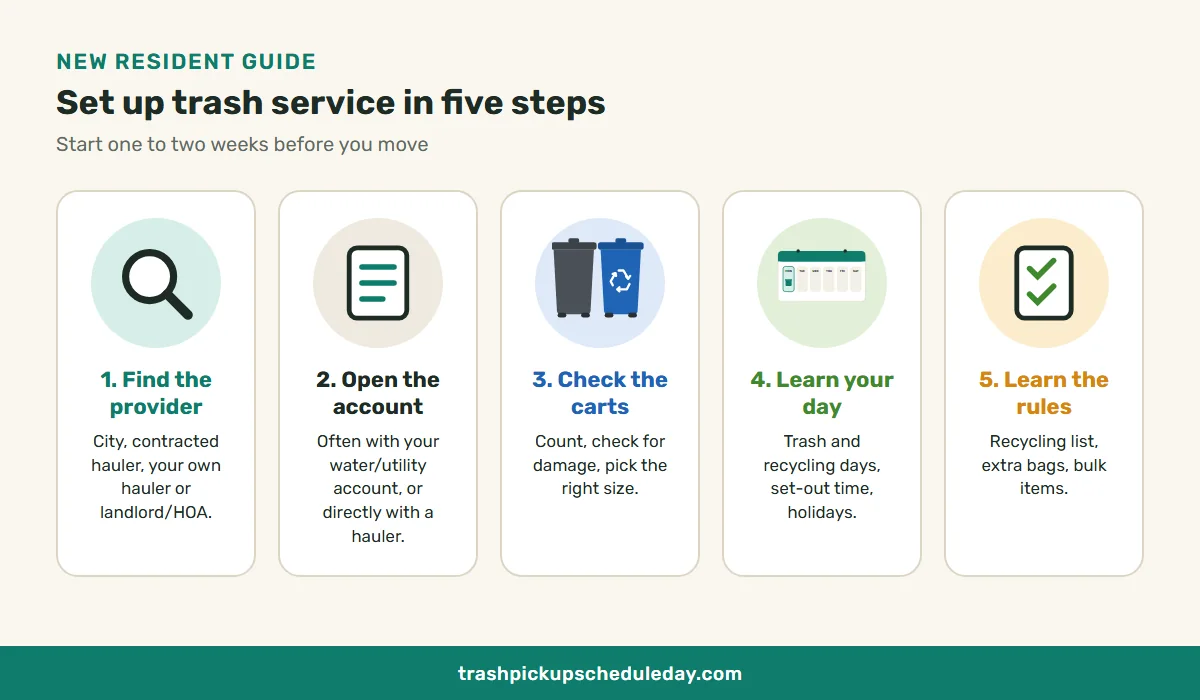
Step 1: Find out who collects trash at your address
There are four common setups in the U.S.:
| Setup | Typical for | What you do |
|---|---|---|
| City-run service | Most single-family homes inside city limits | Usually starts with your city utility account (water/sewer). Fee appears on that bill |
| City-contracted private hauler | Many suburbs | The city picks the company; you may still have to open an account with it |
| Open subscription | Unincorporated county areas, some rural towns | You choose and pay a private hauler directly. No sign-up, no pickup |
| Landlord, HOA or building | Apartments, condos, many rentals | Included in rent or dues; use the building’s dumpsters or chute |
The quickest ways to tell which one applies:
- Look at your city’s sanitation or public works page and check that your address is inside the service area.
- Ask the seller, landlord, property manager or a neighbor who picks up their trash.
- Look at the carts already at the property. Many carry the city’s or hauler’s name.
Our explainer on how trash collection works in the U.S. covers the differences between public and private service in more detail.
Step 2: Set up trash service (open or transfer the account)
City service tied to utilities. In many cities, trash is billed with water and sewer, so opening your utility account also starts trash service. Phoenix is an example: residents start, stop or transfer service through the City Services portal, and trash appears on the water/sewer/city services bill, as explained on the city’s Public Works garbage page. Austin is another. Trash, recycling and composting fees from Austin Resource Recovery are billed through the City of Austin utility account, and you choose one of four trash cart sizes.
Private hauler. Call or sign up online with the hauler, give your move-in date and address, and ask about any start-up or cart delivery fee. In open-subscription areas, compare a few companies. Prices, recycling options and pickup days vary.
Renting. Read your lease. If trash is included, find out where the building’s containers are and whether recycling is separate. If it’s not included, the lease should say whose name the service must be in. Ask before you assume.
Try to set up trash service one to two weeks before you move. Cart delivery isn’t always instant.
Step 3: Check the carts
Carts usually belong to the city or hauler and stay with the house, not the previous owner. When you arrive:
- Count them. You should normally have trash and recycling carts, plus yard waste or compost where offered.
- Check for damage, such as broken lids, wheels or cracked bodies. Replacements are usually free or cheap if you report them early.
- Check the size. If the previous owner had a large cart and you live alone, downsizing may lower your bill. In Austin, downsizing is free.
- Missing carts? Request them. In Phoenix, new-build homes contact Public Works to request containers after starting water service, and the city says delivery can take up to five business days.
Step 4: Learn your pickup day and set-out time
Your collection day is tied to your address, not the old one, even if you only moved across town. Find it on your city’s lookup tool or our directory of city trash pickup schedules. Then confirm:
- Trash day and recycling day. They may differ, and recycling may be every other week.
- Set-out time. Many cities want carts at the curb by early morning. Phoenix and Austin both say by 5:30 a.m. on collection day. Some cities also set the earliest time you can put trash out. See what time trash pickup starts.
- Holiday schedule. Note the next holiday that might shift your day.
Sign up for text or app reminders if your city offers them. In the first few weeks, they save a lot of missed pickups.
Step 5: Learn the local rules (they’re different from your old city)
The rules that change most between cities, and catch new residents out:
- What goes in recycling. Glass, plastic bags and cartons are accepted in some cities and banned in others. Check the local list rather than your old habits. Our recycling bin guide shows the most common differences.
- Extra trash. Some cities charge for bags that don’t fit in the cart. See how much trash you can put out per week.
- Bulk items. Moving creates furniture and mattresses to get rid of, and most cities need a booking or a bulk week. See bulk trash pickup and mattress disposal.
- Cart placement. The usual rules are wheels toward the curb, a few feet from cars and mailboxes, and lids closed.
What to do with moving boxes and packing waste
Moving week can produce more cardboard than a recycling cart holds in a month. Break boxes down flat, recycle what fits, and keep the rest dry for the next pickup. Our guide to cardboard recycling pickup has more. Better still, give sturdy boxes to someone who’s about to move. Foam packing usually can’t go in curbside recycling. Check our page on Styrofoam recycling for options.
First-week checklist
- Confirmed who collects trash at the new address
- Account opened or transferred (utility or hauler)
- Trash and recycling carts present and undamaged
- Pickup days and set-out time noted, reminders turned on
- Local recycling list checked
- A plan for boxes and any bulky items from the move
If your first pickup is missed even though everything is set up, it’s often because the account is still being processed or the address hasn’t been added to a route yet. Contact the provider. Our guide on what to do if trash was never picked up walks through it.
Pingback: Moving Out Checklist: Trash, Recycling and Bulk Items Week by Week