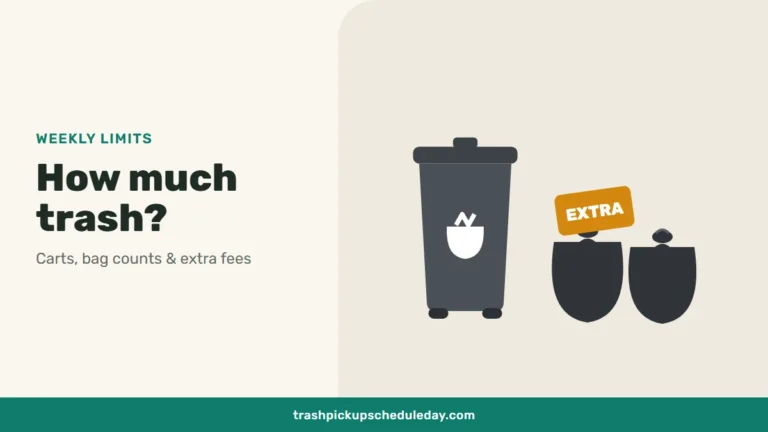
The weekly trash limit for most U.S. homes is whatever fits in your city-issued cart with the lid closed. Anything more is extra trash: some cities collect a few extra bags for free, many charge per bag or require a prepaid sticker, and some won’t take overflow at all.
Cities that collect bags or cans instead of carts usually set a count instead, such as four cans or eight bags a week. Here’s how the different limits work, with real numbers from three cities, and what to do on the weeks when you have more than fits.
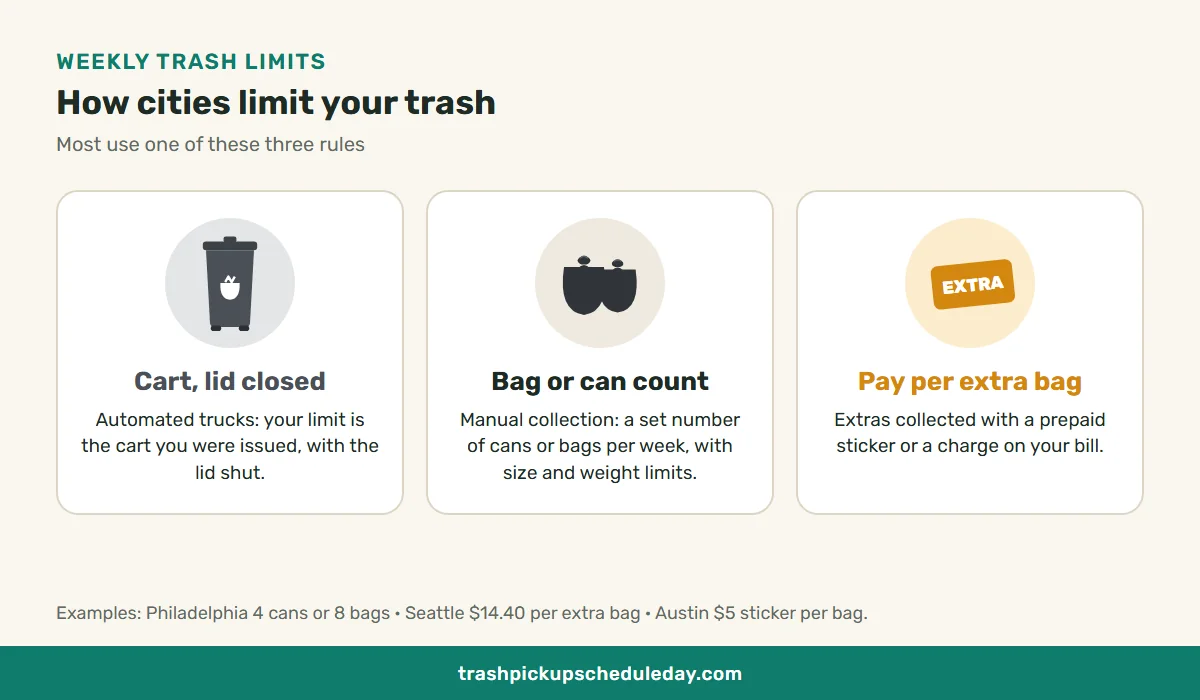
The three ways cities limit trash
1. Cart size (lid must close)
In automated collection, a truck’s arm lifts and empties the cart, so the limit is physical: the cart you were issued, filled so the lid closes flat. Bags stacked on top or wedged in the lid can fall out when the arm tips the cart, and many cities treat an overfull cart as extra trash. Your monthly fee often depends on the cart size you chose, so a bigger cart is a permanent way to raise your limit.
2. Bag or can count
Manual-collection cities set a count per household per week, plus a size and weight limit for each bag or can. Philadelphia is a clear example (details below).
3. Pay-as-you-throw extras
Many cities let you set out extra bags as long as you pay for each one, either with a prepaid sticker or tag on the bag or with a charge added to your bill. This rewards households that throw away less, and it means overflow is collected instead of left behind.
Real weekly trash limits in three cities
| City | Weekly limit | Extra trash |
|---|---|---|
| Philadelphia, PA | Single-family homes: 4 cans or 8 bags (2 bags = 1 can). 2–6 units: 6 cans or 12 bags | Stay within the count (yard waste included). No weekly limit on recycling |
| Seattle, WA | Your subscribed garbage can, lid closed | $14.40 per extra unit (bag or can up to 32 gallons, 60 lb max). Overfull cans are charged too |
| Austin, TX | Your trash cart (four sizes available), lid closed | $5 extra trash sticker per bag (plus tax), or $10.20 per bag (plus tax) without one |
Philadelphia: a count, not a cart
Philadelphia’s residential trash rules set the weekly limit for a single-family home at four cans or eight bags, and the limit includes yard waste. Cans must be metal or another non-corroding material, no larger than 32 gallons. Bags must be sturdy, leak-proof, sealed and 30 to 32 gallons. Recycling has no weekly limit, which is one more reason to keep cardboard and bottles out of the trash. See our Philadelphia garbage collection days for the schedule.
Seattle: every extra bag is billed
Seattle Public Utilities charges $14.40 per extra unit, effective April 1, 2026 (rates change each April). One unit is a bag or personal can of up to 32 gallons and 60 pounds, set next to your cart and labeled with your address. A cart too full to close is charged the same fee. Details are on SPU’s extra garbage page.
Austin: stickers from the grocery store
Austin Resource Recovery collects extra bags placed beside the cart on your pickup day. Each bag needs a $5 extra trash sticker (plus tax), sold at most local grocery stores. Without a sticker, the city charges $10.20 per bag (plus tax). Extra bags must be 35 pounds or less and no larger than 40 gallons. If you’re regularly over, a larger cart costs a one-time $15 exchange fee plus the higher monthly rate. See the city’s extra trash stickers page.
What counts toward your limit, and what doesn’t
Usually not counted against your trash limit:
- Recycling, collected separately and often unlimited if it fits the recycling cart or the rules.
- Bulk items like furniture and mattresses, handled through bulk trash pickup.
- Yard waste, where there’s a separate yard waste program (Philadelphia is an exception, since there it shares the trash limit).
Usually counted, or not allowed at all:
- Bags placed on top of a full cart.
- Loose trash in boxes.
- Construction and remodeling debris, which most residential programs refuse whatever the volume.
- Hazardous items, which need their own disposal route.
What to do when you have too much trash
One-off overflow (a party, a clean-out, holidays): buy stickers or pay the extra bag fee, or hold the bags until next week if they won’t smell or attract animals. After holiday weeks, check whether your schedule moved. Our guide to holiday trash delays explains how.
Regular overflow: move up a cart size, or look at what’s filling it. Cardboard broken down into the recycling cart, food scraps into a compost program, and glass or plastic that belongs in recycling often free up a surprising amount of space. Our tips on reducing household trash go further.
Big one-time jobs (moving, renovation, estate clean-out): ask about a bulk pickup, take loads to a transfer station, or rent a dumpster if you have the space and a permit where required.
Why overflow gets left behind
If the crew skipped your extras, the usual reasons are bags without the required sticker, a lid that wouldn’t close, bags that are too heavy, or extras placed where the truck arm can’t reach. Most cities post their set-out rules with the extra-trash rules. If everything was in order, follow your city’s process for a missed trash pickup.
Pingback: when trash is delayed by a holiday