
Last updated: September 2026 | Reviewed by Fran A., Founder & Editor-in-Chief
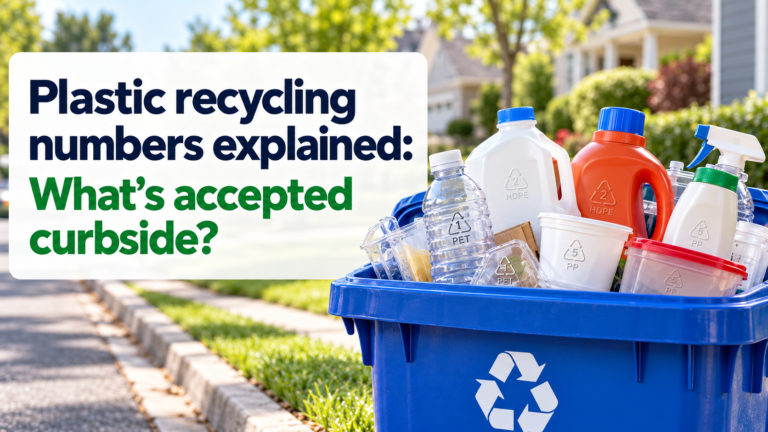
Flip over almost any plastic container and you’ll find a small number inside a triangle. Most people assume it means “recyclable.” It doesn’t.
That number tells you what type of plastic the item is made of — not whether your city will take it. This guide explains which plastic recycling numbers are accepted curbside in most U.S. programs, which ones almost never are, and the one rule that matters more than the number itself.
⚠️ Quick Answer
| Number | Accepted Curbside in Most U.S. Programs? |
|---|---|
| #1 PET | ✅ Yes — bottles |
| #2 HDPE | ✅ Yes — jugs and bottles |
| #3 PVC | ❌ Rarely |
| #4 LDPE | ❌ Rarely curbside (bags go to store drop-off) |
| #5 PP | ⚠️ In many programs — check locally |
| #6 PS | ❌ Rarely |
| #7 Other | ❌ Rarely |
The rule that matters most: Most programs accept plastic bottles, jugs, and tubs — not every item with an “accepted” number. Shape matters as much as the number.
What the Number Inside the Triangle Really Means
The number is called a Resin Identification Code (RIC). It was created by the plastics industry in 1988 to help recycling facilities identify types of plastic resin. The system is now maintained by ASTM International.
Three things most people don’t know about it:
1. It’s not a recycling symbol. The code identifies the resin. It says nothing about whether a recycling program in your area accepts it or whether a buyer exists for that material.
2. The arrows are being phased out. The traditional “chasing arrows” triangle is widely mistaken for a promise of recyclability. The current ASTM standard uses a solid triangle instead, to reduce that confusion — though you’ll still see the arrows on plenty of packaging.
3. Some states now regulate recycling claims. California’s SB 343, for example, restricts the use of the chasing arrows and “recyclable” claims on products that aren’t actually collected and recycled in most of the state.
The bottom line: treat the number as an ingredient label, not a recycling guarantee.
Plastic #1 – PET or PETE (Polyethylene Terephthalate)
Common items: Water bottles, soda bottles, juice bottles, salad dressing bottles, peanut butter jars, some clear food containers.
Curbside acceptance: ✅ Widely accepted — especially bottles.
PET bottles are the most recycled plastic in the United States and have one of the strongest resale markets. They’re commonly recycled into new bottles, polyester fiber for clothing and carpet, and packaging.
Watch out for: Clear clamshells and trays (berry containers, salad boxes, bakery trays). They’re often also #1, but many programs reject them because they’re made differently from bottles and have weaker markets. Check your city’s list for “clamshells” or “thermoforms.”
How to prepare: Empty, quick rinse, cap back on (unless your city says otherwise).
Plastic #2 – HDPE (High-Density Polyethylene)
Common items: Milk jugs, juice jugs, laundry detergent bottles, shampoo and conditioner bottles, household cleaner bottles.
Curbside acceptance: ✅ Widely accepted — bottles and jugs.
HDPE is sturdy, has strong demand, and is recycled into items like new bottles, pipe, plastic lumber, and outdoor furniture.
Watch out for: HDPE plastic bags and wraps. Even though some bags are #2, film and bags don’t go in the curbside bin — they jam sorting machines. Take them to a store drop-off if one is available.
How to prepare: Empty completely — especially detergent and cleaner bottles. Cap on.
Plastic #3 – PVC (Polyvinyl Chloride)
Common items: Pipes, vinyl siding, some blister packs, garden hoses, shower curtains, some clear food packaging.
Curbside acceptance: ❌ Rarely accepted.
PVC contains chlorine and can contaminate the recycling of other plastics — especially PET. Very few curbside programs accept it.
What to do instead: Put small household PVC items in the trash unless your city says otherwise. Construction PVC (pipe, siding) should go to a construction waste recycler or transfer station.
Plastic #4 – LDPE (Low-Density Polyethylene)
Common items: Grocery bags, bread bags, produce bags, dry cleaning bags, plastic wrap, some squeeze bottles, some flexible lids.
Curbside acceptance: ❌ Rarely accepted curbside.
Most #4 items are thin, flexible film. Film is the single biggest contaminant at U.S. sorting facilities because it wraps around rotating screens and shuts down equipment.
What to do instead: Many grocery and big-box stores offer plastic bag and film drop-off bins. These programs usually take clean, dry bags and wraps — check what your local drop-off accepts before you go. Better still, switch to reusable bags.
Plastic #5 – PP (Polypropylene)
Common items: Yogurt cups, margarine and butter tubs, some takeout containers, bottle caps, syrup bottles, some medicine bottles.
Curbside acceptance: ⚠️ Accepted in many U.S. programs — but not all.
Polypropylene acceptance has grown in recent years as industry efforts have expanded the market for it. It’s now one of the “gray area” numbers: accepted in many cities, rejected in others.
How to prepare: Empty and rinse tubs. Put lids back on or recycle them separately, depending on local rules.
Check locally: If your city’s accepted list says “tubs” or “#5,” you’re good. If it only says “bottles and jugs,” #5 tubs probably aren’t accepted.
Plastic #6 – PS (Polystyrene)
Common items: Foam cups, foam takeout containers, foam egg cartons, packing peanuts, meat trays, some rigid disposable cutlery and clear cups.
Curbside acceptance: ❌ Rarely accepted.
Polystyrene foam is mostly air, which makes it bulky, lightweight, and expensive to transport and process. Several U.S. states and many cities have banned foam food containers entirely.
What to do instead: Trash, unless your area has a dedicated foam drop-off site. Packing peanuts can often be reused or dropped off at shipping stores that accept them — call first.
Plastic #7 – Other
Common items: Some large water cooler jugs, some baby bottles, multi-layer packaging, some food pouches, and “compostable” bioplastics (PLA).
Curbside acceptance: ❌ Rarely accepted.
#7 is a catch-all for plastics that don’t fit categories 1–6 — including mixtures of different resins. Because the category covers so many different materials, sorting facilities can’t reliably process it.
Watch out for “compostable” plastics. Items made from PLA are often labeled #7 or “compostable.” They are not recyclable, and they contaminate recycling streams. They also usually require industrial composting — check whether your city’s green bin program accepts them before putting them there.
Complete Plastic Recycling Numbers Chart
| Code | Plastic | Common Items | Curbside | Better Option If Not Accepted |
|---|---|---|---|---|
| #1 | PET / PETE | Water & soda bottles | ✅ Widely | — |
| #2 | HDPE | Milk jugs, detergent bottles | ✅ Widely | — |
| #3 | PVC | Pipes, blister packs | ❌ Rarely | Trash / construction recycler |
| #4 | LDPE | Bags, film, wrap | ❌ Rarely | Store drop-off for clean film |
| #5 | PP | Yogurt tubs, caps | ⚠️ Often | Check local list |
| #6 | PS | Foam cups, takeout containers | ❌ Rarely | Trash / foam drop-off |
| #7 | Other | Mixed plastics, PLA | ❌ Rarely | Trash |
Shape Matters More Than the Number
Here’s the rule most people never hear: many U.S. programs accept plastics by shape, not just by number.
The most commonly accepted shapes are:
- Bottles (narrow neck — water, soda, shampoo)
- Jugs (with handle — milk, detergent)
- Tubs (wide mouth — yogurt, margarine) in many programs
Items that are often rejected even when they carry an “accepted” number:
- Clamshells and trays
- Plastic cutlery and straws (too small)
- Plastic toys and hangers (mixed materials — some cities, such as New York City, do accept most rigid plastics)
- Bags, film, and wrap of any number
- Anything under about 2 inches (falls through sorting screens)
Black Plastic – Why It Often Gets Rejected
Black plastic takeout containers and trays have a special problem: many sorting facilities use optical scanners that identify plastics by reflecting light off them. Black plastic colored with carbon black absorbs that light, so the scanners often can’t identify it — and it ends up sent to landfill even if the resin itself is recyclable.
Some programs explicitly exclude black plastic. If yours doesn’t mention it, check with your city or hauler.
Common Plastic Items – Quick Decoder
| Item | Typical Number | Usually Accepted Curbside? |
|---|---|---|
| Water bottle | #1 | ✅ Yes |
| Soda bottle | #1 | ✅ Yes |
| Milk jug | #2 | ✅ Yes |
| Laundry detergent jug | #2 | ✅ Yes (empty) |
| Shampoo bottle | #1 or #2 | ✅ Yes (empty) |
| Yogurt cup | #5 | ⚠️ Often |
| Bottle caps | #5 (usually) | ⚠️ Leave on the bottle if your city allows |
| Berry clamshell | #1 | ⚠️ Varies |
| Takeout container (clear) | #1 or #5 | ⚠️ Varies |
| Takeout container (black) | Varies | ❌ Often rejected |
| Foam cup or container | #6 | ❌ No |
| Grocery bag | #2 or #4 | ❌ No — store drop-off |
| Plastic wrap | #4 | ❌ No |
| Plastic utensils | #5 or #6 | ❌ No — too small |
| “Compostable” cup | #7 (PLA) | ❌ No |
How to Prepare Plastics for Recycling
1. Empty it completely. Leftover liquid or food can contaminate other recyclables.
2. Give it a quick rinse. It doesn’t need to be spotless.
3. Leave caps on bottles — unless your city says otherwise. Loose caps are too small to sort, but caps screwed on travel with the bottle.
4. Don’t crush bottles flat if your program asks you not to — some sorting equipment identifies containers by shape.
5. Keep plastics loose. Never put recyclables in a plastic bag unless your city specifically instructs it.
👉 Related: How to Sort Trash for Recycling: A Visual City-by-City Guide
Why Your City Accepts Different Plastics Than Your Neighbor’s
Plastic acceptance depends on three things:
The sorting facility. Your city’s recyclables go to a Materials Recovery Facility (MRF). Its equipment determines which plastics it can separate.
The market. A plastic is only recyclable if someone buys it to make something new. #1 and #2 bottles have steady buyers; #3, #6, and #7 generally don’t.
Single-stream vs. dual-stream collection. How your city collects recyclables affects contamination levels and which materials are practical to accept.
👉 Related: Single-Stream Recycling vs Sorted Recycling: What’s Your City?
How to Check Which Plastic Numbers Your City Accepts
1. Your city’s accepted materials list. Search “[your city] recycling what’s accepted.” Look for plastic numbers and shapes.
2. Your hauler’s website. Private haulers publish accepted materials by service area.
3. A recycling app. Many cities partner with apps that let you search an item and get your local answer. 👉 Best Recycling Apps for U.S. Residents
4. The How2Recycle label. Many packages now carry a How2Recycle label saying whether the item is widely recyclable, check locally, or store drop-off.
5. Call 311. Most large cities can answer “can I recycle this?” questions by phone.
Frequently Asked Questions
Which plastic recycling numbers are accepted curbside?
In most U.S. programs, #1 (PET) and #2 (HDPE) bottles and jugs are accepted. #5 (PP) tubs are accepted in many programs. #3, #4, #6, and #7 are rarely accepted curbside. Always confirm with your city.
Does the recycling symbol mean an item is recyclable?
No. The number inside the triangle is a resin identification code that identifies the type of plastic. It doesn’t mean your local program accepts it.
Is #5 plastic recyclable?
Increasingly, yes — many U.S. programs now accept #5 tubs and containers. But not all do. Check whether your city lists “#5” or “tubs” on its accepted materials list.
Why isn’t #1 clamshell packaging accepted if #1 bottles are?
Clamshells and trays are made differently from bottles and have weaker markets, so many sorting facilities reject them even though they’re also #1 plastic.
Can I recycle plastic bags curbside?
Almost never. Bags and film jam sorting equipment. Take clean, dry bags to a store drop-off bin if one is available near you.
Is black plastic recyclable?
Often not. Optical sorting machines at many facilities can’t detect black plastic, so it’s frequently sent to landfill. Check your local rules.
What about plastic with no number?
If there’s no number, most programs treat it as unknown plastic. Unless it’s a bottle, jug, or tub your city clearly accepts, put it in the trash.
Are “compostable” plastics recyclable?
No. Compostable bioplastics (often labeled #7 or PLA) contaminate recycling. They usually need industrial composting — check whether your green bin program accepts them.
Related Recycling Guides
- What Goes in Recycling Bin USA? Complete Curbside Guide 2026
- Single-Stream Recycling vs Sorted Recycling: What’s Your City?
- How to Sort Trash for Recycling: A Visual City-by-City Guide
- Glass Recycling Pickup Schedule – Does Your City Accept Glass?
- Cardboard Recycling Day Near Me – How to Prepare & Schedule
- Best Recycling Apps for U.S. Residents
- Complete U.S. Trash Pickup Guide 2026 – Everything You Need to Know
This guide reflects common U.S. curbside recycling practice as of September 2026. Accepted plastics vary by city and hauler — always confirm with your local program. If you notice an error, contact us and we’ll review it within 48 hours.
Written and maintained by Fran A., Founder & Editor-in-Chief — trashpickupscheduleday.com
Pingback: How to Choose Party Plastic Glasses for Your Event | DHgate Lifestyle Guide