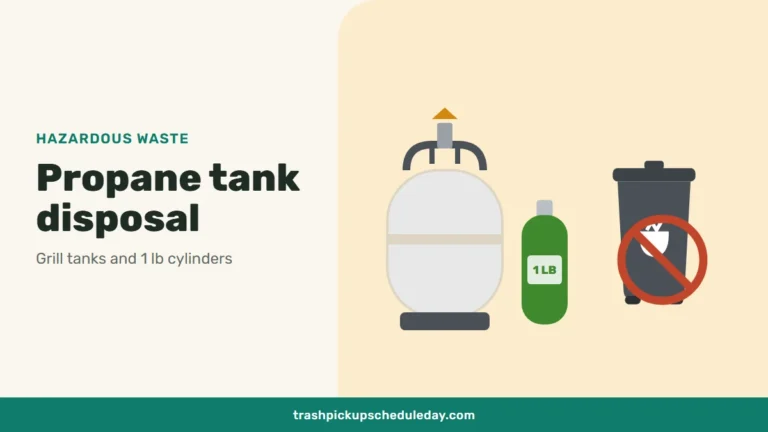
For propane tank disposal, the short answer is: don’t put the tank in your trash or recycling cart, even if you think it’s empty. A 20 lb grill tank goes back through a tank exchange or to a propane dealer or household hazardous waste site. Small 1 lb camping cylinders go to a hazardous waste drop-off in most places. Leftover gas can ignite when the truck compacts its load, so crews and landfills treat pressurized cylinders as a hazard.
Which route is right depends on the tank’s size and condition. Here’s how to sort it out.
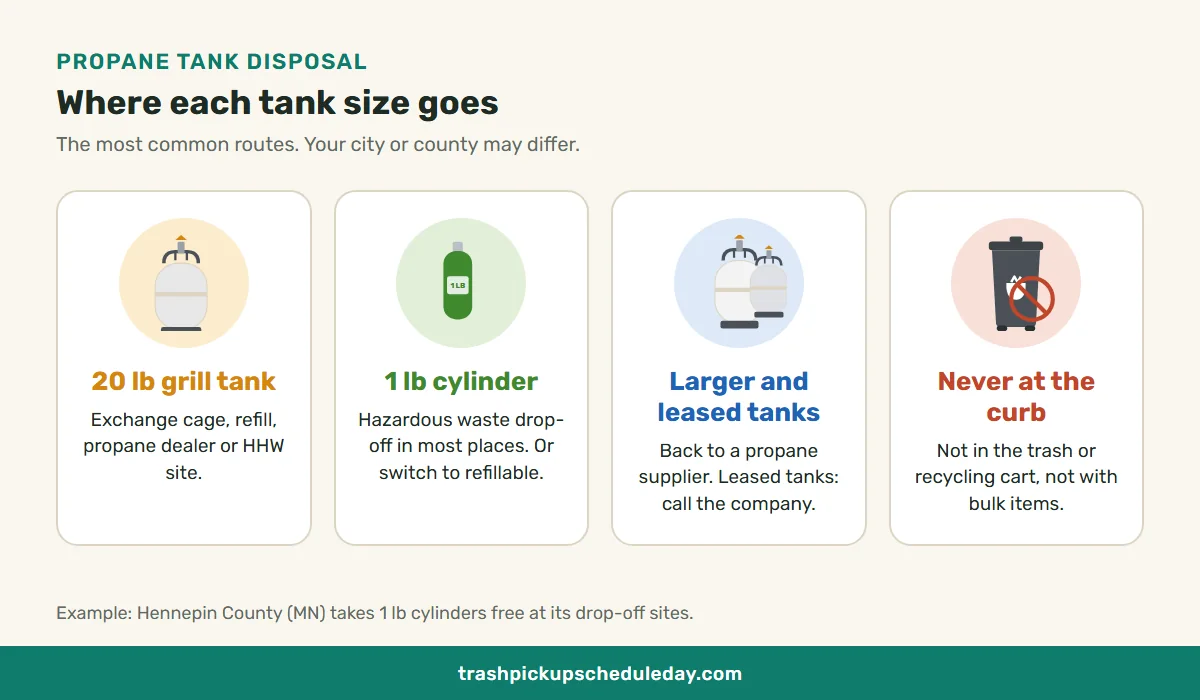
20 lb grill tanks: exchange it, refill it or hand it in
The standard barbecue tank is designed to be reused for years, so disposal is rarely the first step.
- Exchange it. New Hampshire’s environmental agency points residents to exchange programs such as AmeriGas and Blue Rhino, where you swap a used 20 lb tank for a filled one. Exchange cages sit outside many grocery, hardware and home stores.
- Refill it. If the tank is in good shape, a propane dealer or refill station can fill it.
- Hand in a tank you no longer need. Ohio’s Recycle Right program notes that Blue Rhino also takes back 20 lb tanks for free when you just want to get rid of one. Propane dealers and many household hazardous waste (HHW) programs accept them too. Some charge a small fee.
Old tanks are a special case. A refill station may refuse a tank that is too old or has an outdated valve. Older cylinders without an overfill prevention device (the triangular valve handle has been standard since 2002) can’t be refilled, and cylinders need to be requalified 12 years after the manufacture date stamped on the collar. Those tanks still go to an exchange, dealer or HHW site, not the curb.
1 lb camping and torch cylinders
The small green cylinders used for camp stoves, lanterns and torches are usually single-use, which makes them the harder case. Rules vary more than for grill tanks:
| Where | What the official guidance says |
|---|---|
| Hennepin County, MN (Minneapolis area) | One-pound cylinders only at county drop-off sites, at no charge. Empty metal tanks can also go to a scrap metal recycler |
| Sonoma County, CA | Propane cylinders can’t be recycled at the curb. Take them to a hazardous waste facility |
| Los Angeles County, CA | Single-use cylinders cost local governments about $10 to $25 each to handle. The county urges refillable 1 lb cylinders instead |
| North Carolina | The state agriculture department says small one-pound cylinders may go in the regular trash |
North Carolina shows why you should check before you toss one. The same cylinder that’s allowed in household trash there is banned from curbside service in much of California. When your city’s page doesn’t mention propane, treat the cylinder as household hazardous waste.
To cut down on the problem, switch to refillable 1 lb cylinders. Los Angeles County’s program lists refill locations through refuelyourfun.org.
Larger tanks, RV tanks and leased tanks
Tanks bigger than the grill size, such as 30 to 100 lb cylinders and RV tanks, are best returned to a propane supplier. Many HHW programs cap what they take by size. King County, Washington, for example, says its transfer stations don’t accept propane tanks of any size, while its hazardous waste sites take only smaller cylinders. Leased tanks belong to the company that installed them: call them to pick it up.
How to get a tank ready to drop off
- Close the valve fully, even if you think the tank is empty.
- Keep it upright and outdoors, away from heat sources, until you take it in.
- Transport it upright and secured so it can’t roll, with a window cracked. Take it straight to the drop-off and don’t leave it in a hot car.
- Don’t puncture, crush or burn a cylinder, and don’t try to vent leftover gas yourself.
- Call ahead. HHW sites often run by appointment and may have size or quantity limits. See our guide to hazardous waste pickup days for how these programs work.
Never set a propane tank inside your trash or recycling cart, and don’t leave it next to the cart for bulk pickup. Most curbside programs list compressed gas cylinders among the items crews won’t take.
Frying a turkey this week? Check the tank first
Thanksgiving is the busiest week of the year for outdoor fryers, which run on the same 20 lb tanks. The CPSC’s turkey fryer tips call for at least 2 feet between the propane tank and the burner, using the fryer outdoors away from buildings, and doing a leak check before you light it. If your tank is dented, rusted or past its requalification date, exchange it before the holiday, not after.
Trash collection also shifts on Thanksgiving week in many cities. Check the Thanksgiving trash pickup schedule before you set out carts.
Propane tank disposal FAQ
Can I throw away an empty propane tank? Not in most places. Few tanks are truly empty, and haulers can’t check. Exchange or return a 20 lb tank, and take a 1 lb cylinder to a hazardous waste drop-off unless your city says otherwise.
Does Blue Rhino take tanks from other brands? Exchange programs generally accept standard 20 lb grill tanks regardless of brand, as long as they’re not badly damaged. Ask at the store if yours is old or rusty.
Can I recycle a propane tank as scrap metal? Some scrap yards take empty cylinders, as Hennepin County notes, but many won’t accept one with a valve still attached. Call first.
Where do I find my local drop-off? Search your city or county name with “household hazardous waste,” or start from your city’s trash pickup page. Cities like Minneapolis, Seattle and Los Angeles list their hazardous waste options there.
Sources: Hennepin County, one-pound propane cylinders, Los Angeles County, reusable propane cylinders, New Hampshire DES, propane tanks, King County, compressed gas cylinders and CPSC turkey fryer safety tips. As of November 2026.
Pingback: Household Hazardous Waste Pickup Day: Find Drop-Off Near You