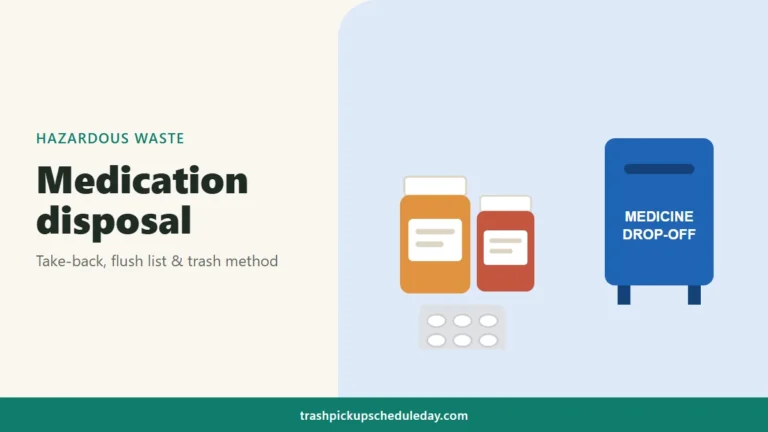
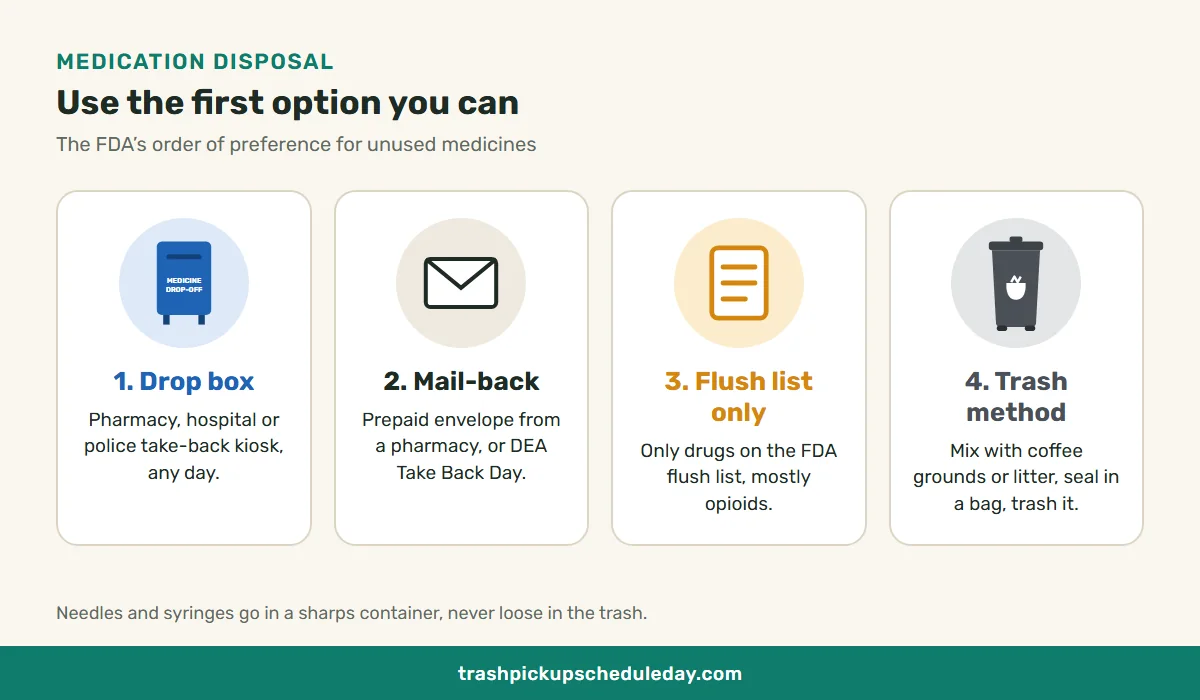
Safe medication disposal has a clear order of preference. Use a take-back option first: a pharmacy or police drop box, a mail-back envelope, or a DEA Take Back Day. Only if none is available should you use the FDA flush list for a small set of dangerous drugs, or the household trash method for everything else. Medicines don’t go in curbside recycling, and there’s no “medication pickup day” with your regular trash.
Below: how each option works, the next national Take Back Day, and what to do with items that need special handling.
1. Take-back: the best medication disposal option
For medication disposal, the FDA says the best way to get rid of most unused or expired medicines is to use a take-back option right away. There are three kinds:
- Permanent drop boxes (kiosks). Many pharmacies, hospitals and police stations have a secure box you can use any day the building is open. Pills and capsules are almost always accepted. Liquids, inhalers and needles often aren’t. Rules vary by site, so read the box.
- Mail-back envelopes. Some pharmacies sell or give out prepaid envelopes. You fill one with medicines and drop it in the mail.
- DEA National Prescription Drug Take Back Day. Twice a year, local police and partners run free, anonymous collection sites nationwide, usually from 10 a.m. to 2 p.m. The 2026 events were Saturday, April 25 and Saturday, October 24. The next one is expected in spring 2027. Dates and a site locator are posted at DEATakeBack.com.
You don’t have to wait for Take Back Day. A permanent drop box is usually closer and always available. Search “drug take back near me” or check your pharmacy chain’s website.
Before you drop off: leave pills in their original bottles if the site allows it, but scratch out your name and prescription number. The FDA also tells people to remove personal information from empty packaging before throwing it away.
2. The FDA flush list: a short list of dangerous drugs
Flushing is not the default. The FDA keeps a short “flush list” of medicines that are especially dangerous, sometimes deadly in one dose, if a child or pet gets them or someone misuses them. Only for these, and only when you can’t get to a take-back option quickly, does the FDA say to flush them down the toilet.
The list is mostly opioids, listed by active ingredient: buprenorphine, fentanyl, hydrocodone, hydromorphone, meperidine, methadone, morphine, oxycodone, oxymorphone and tapentadol. It also includes a few others, such as sodium oxybate, diazepam rectal gel and methylphenidate patches. Check the FDA flush list for the exact products.
The FDA’s own rule is simple: don’t flush a medicine unless it’s on that list.
3. Household trash: the last resort for everything else
If no take-back option is available and the medicine isn’t on the flush list, the FDA’s household-trash method is:
- Mix the medicine (don’t crush pills) with something unappealing, such as dirt, cat litter or used coffee grounds.
- Seal the mixture in a plastic bag or a container with a lid.
- Throw it in your household trash.
- Scratch out personal information on the empty bottle or packaging, then recycle or trash it.
This makes the medicine unattractive to children, pets and anyone digging through trash. It’s better than leaving old pills in a cabinet, but take-back is still preferred.
Items that need different handling
| Item | What to do |
|---|---|
| Needles, syringes, lancets | Never loose in trash or recycling. Use a sharps container and your local sharps program or mail-back service |
| Inhalers | Don’t puncture or burn them. Ask your pharmacy or local hazardous waste program |
| Liquid medicines | Check the drop box rules. Otherwise use the trash method, mixed with an absorbent |
| Pet medications | Same options as human medicines |
For other household products that need special disposal, see our guide to household hazardous waste pickup days.
Don’t put medicines in the recycling bin
Pill bottles may be plastic, but medicine itself is never recyclable, and loose pills in a cart can reach children and animals at the curb. Empty, label-free bottles can go in recycling only if your city accepts that size and type of plastic. Many don’t take small containers. Our guide to what goes in the recycling bin explains the usual rules.
Make medication disposal a habit
A good time to clear out the medicine cabinet is twice a year, around the DEA Take Back Days in April and October. Moving house is another. See our moving out checklist. Keep a small bag of expired medicines out of reach, and drop it at a pharmacy kiosk on your next visit.
Pingback: Household Hazardous Waste Pickup Day: Find Drop-Off Near You