Whether you can throw away a TV depends on your state. In 15 states and Washington, DC, electronics like TVs are banned from landfills, so a TV can’t go out with the regular trash. Elsewhere it may be legal, but most cities still won’t take a TV in your cart, and many won’t take it as bulk trash either. In nearly every case, the right answer is electronics recycling, which is often free for households.
Here’s the state list, why TVs get special treatment, and where to take an old set.
States where you can’t throw a TV in the trash
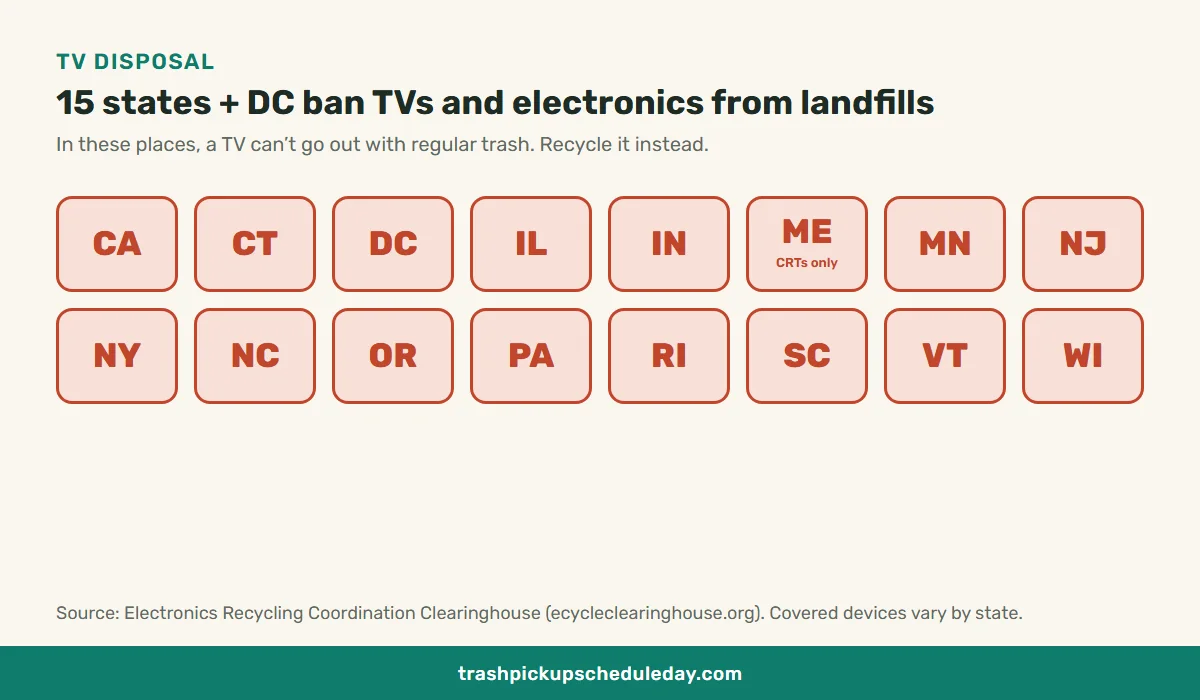
According to the Electronics Recycling Coordination Clearinghouse, these have a landfill ban on electronics:
California · Connecticut · District of Columbia · Illinois · Indiana · Maine · Minnesota · New Jersey · New York · North Carolina · Oregon · Pennsylvania · Rhode Island · South Carolina · Vermont · Wisconsin
Maine’s ban applies only to CRT devices (old tube TVs and monitors) and mercury-containing products.
The covered products vary by state. TVs and computer monitors are almost always included. Laptops, printers and other devices sometimes are. Your state environmental agency’s e-waste page has the exact list.
Many more states have e-waste recycling laws that require manufacturers to fund collection programs, even without a landfill ban. The Clearinghouse counts 25 states plus DC with e-waste laws. In those states, free drop-off sites for TVs are usually easier to find.
Why TVs are treated differently
- Old CRT TVs (the deep “tube” sets) contain several pounds of lead in the glass.
- Flat screens can contain mercury (older LCDs with fluorescent backlights), circuit boards with heavy metals, and plastics with flame retardants.
- Valuable materials like copper, aluminum, glass and precious metals can be recovered when a TV is recycled properly.
Where to take a TV instead of throwing it away
- State or manufacturer programs: in states with e-waste laws, there’s usually a list of free collection sites on the state environmental agency’s website.
- City or county drop-off: recycling centers, transfer stations and household hazardous waste sites often accept TVs, sometimes with a fee for large CRTs.
- Collection events: many cities run electronics recycling days. See our guide to electronics recycling pickup.
- Retailer take-back: some electronics and big-box stores accept TVs, sometimes with size limits or a fee. Check before you go.
- Retailer haul-away: when you buy a new TV with delivery, ask whether they’ll take the old one.
- City bulk pickup: some cities collect TVs curbside by appointment, separately from furniture. Check your bulk pickup rules before setting one out.
How much TV recycling costs
In states with manufacturer-funded e-waste programs, dropping off a TV at a program collection site is usually free for households. Outside those programs, expect that some sites charge a fee, especially for large or old CRT sets, which are heavy and costly to process. Retailer take-back and haul-away programs may also charge per TV or limit screen sizes. Call before you load the car, and ask:
- Do you accept TVs from households, and is there a size limit?
- Is it free, or is there a fee for CRTs or large screens?
- Do I need an appointment or proof of residence?
If a site wants a fee and you’re in a state with an e-waste law, check the state’s list of program sites first. A free option is often nearby.
If your TV still works
Working TVs, especially flat screens, can often be sold, given away or donated. Many thrift stores no longer accept old tube TVs, though.
Before you get rid of a smart TV
Smart TVs store account logins for streaming apps. Do a factory reset in the settings menu to sign out of accounts and erase personal data before the TV leaves your home.
What happens if you put a TV out with the trash anyway
In landfill-ban states, the crew will usually leave it at the curb, often with a sticker explaining why, and some cities can fine for improper set-out. Even where it’s legal, a TV left with trash is a common reason for a skipped pickup. See why trash isn’t picked up.
Other electronics with batteries, like laptops, phones and tablets, have extra fire risk. Our battery recycling guide explains what to do with them.