Leaf collection in most U.S. cities runs on its own calendar, separate from your regular trash day. The quickest way to find your date is your city’s leaf page or tracker, usually under Public Works or Sanitation. Search “[your city] leaf collection” and look for a zone map or address lookup.
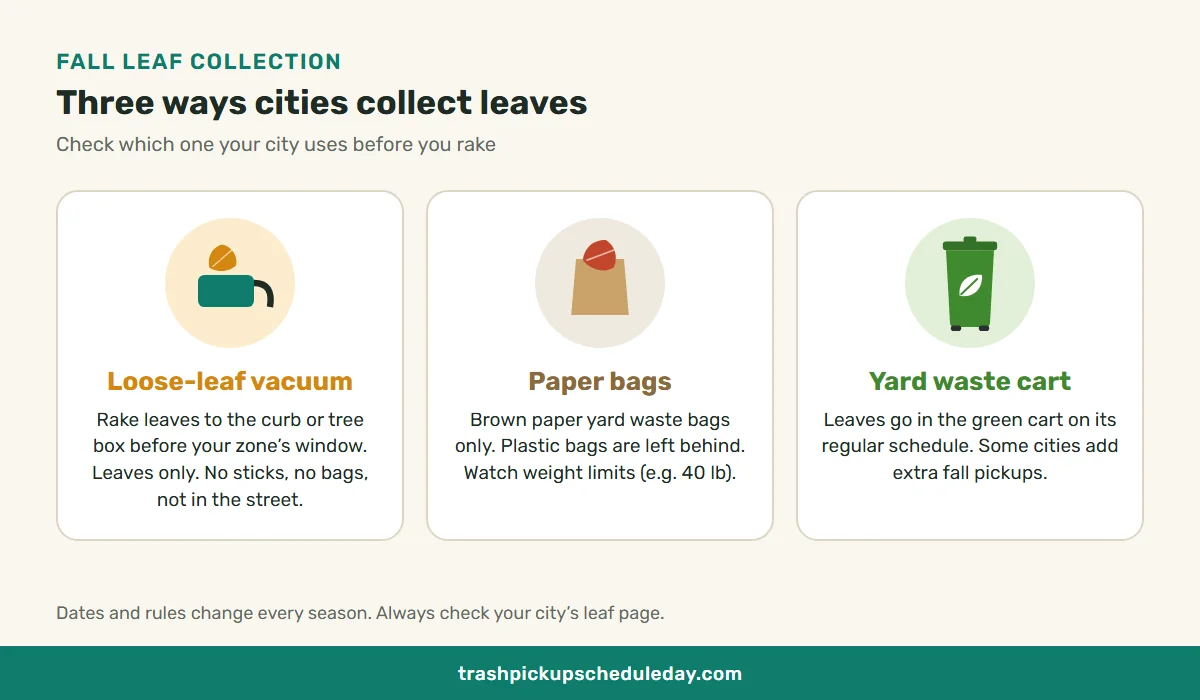
What changes from city to city is the method: some send vacuum trucks for loose leaves, some only take leaves in paper bags, and some just want them in your yard waste cart. Put leaves out the wrong way and they stay at the curb. This guide explains the three systems, shows real 2026 schedules, and covers what to do if your city doesn’t collect leaves at all.
The three leaf collection systems
Loose-leaf vacuum collection
Crews drive a truck with a large vacuum hose down each street and suck up leaves you’ve raked to the curb or into the tree lawn. Each neighborhood usually gets two or more passes during the season, assigned by zone or section.
The rules are strict because the vacuum jams easily:
- Leaves only. Branches, rocks, pumpkins and bagged grass get your pile skipped.
- Keep piles out of the street. Leaves in the gutter clog storm drains and block traffic, and many cities won’t collect them there.
- Rake out before your window opens, not after the truck has passed.
- Keep cars, bins and basketball hoops away from the pile so the hose can reach it.
Bagged leaf collection
Other cities only take leaves in paper yard waste bags, sometimes on your normal collection day and sometimes on special fall dates. Plastic bags are the most common reason bagged leaves are left behind: they can’t go into a composting facility, so crews skip them. Watch for weight limits too. Philadelphia, for example, caps yard waste bags and containers at 40 pounds when filled.
Yard waste cart
If you already have a green cart for yard waste, leaves may simply go in that cart on its normal schedule. Some cities add extra fall pickups or let you set out a few paper bags next to the cart. It’s the simplest system, but in heavy-leaf years the cart fills fast.
Real 2026 leaf collection schedules
These examples show how differently cities organize the season. Check your own city’s page, since dates move every year and can slip because of weather.
| City | System | 2026 season | How to find your date |
|---|---|---|---|
| Washington, DC | Loose leaves raked into the tree box (vacuum) | Starts week of Nov 2; four sections, two passes each | DPW Leaf Tracker, MyDPW app or 202-671-LEAF |
| Philadelphia, PA | Mechanical collection in heavy-leaf areas plus bagged drop-off sites | Nov 2 – Dec 19 | City leaf recycling page and flyer |
| Noblesville, IN | Loose-leaf pickup | Oct 12 – Dec 11 | City leaf collection page |
| Salisbury, NC | Vacuum trucks in fall and winter; bagged leaves the rest of the year | Mid-October to about mid-March | City zone map and address lookup |
How Washington, DC runs it
DC is a good example of a section-based vacuum program. For 2026–27, DPW lists these estimated first-pass cycles:
- Section A: Nov 2 – Nov 15
- Section B: Nov 16 – Nov 29
- Section C: Nov 30 – Dec 13
- Section D: Dec 14 – Dec 28
Each section is collected twice. Residents rake leaves into the tree box on the Sunday before their collection week, or to the curb in front of the home if there’s no tree box. Leaves don’t need to be bagged, but if you do bag them, only paper bags are accepted. DPW does not publish a street-by-street schedule in advance, and there’s no collection on Thanksgiving, Christmas or New Year’s Day. Details and the tracker are on the DC DPW leaf collection page. For regular DC trash days, see our Washington, DC trash pickup schedule.
How to find your leaf pickup week
- Search your city’s leaf page. Try “[city] leaf collection 2026” or “[city] leaf pickup map”. Results from your city’s own .gov site or its public works department are the ones to trust.
- Look for a zone or section map. Most vacuum programs assign dates by area, not by your trash day.
- Check whether you need to sign up. A few cities only collect when you submit a request online or through 311.
- Sign up for alerts. Leaf schedules slip after storms, snow or heavy leaf drops, and texts or app notices are the fastest way to hear about delays.
- Confirm you’re in city limits. If a private hauler handles your trash, the city leaf program may not cover your street. Ask the hauler about fall yard waste instead.
Not sure who collects at your address? Our guide to finding your city’s pickup day walks through it.
Why leaves get left at the curb
When a pile is skipped, it’s almost always one of these:
- Plastic bags in a paper-bag or vacuum program.
- Mixed debris: sticks, grass clippings, rocks or holiday decorations in a vacuum pile.
- Leaves in the street instead of on the tree lawn or behind the curb.
- Raked out too late, after the crew has already passed your block.
- Blocked access: a parked car or trash cart between the truck and the pile.
- Over the weight limit for bags or containers.
If you followed the rules and the crew still missed you, wait until your section’s window has closed. Many cities ask for that before you report it. DC, for example, asks residents to wait seven days after their section’s cycle ends before reporting a missed collection through 311.
If your city doesn’t pick up leaves
Plenty of towns have no leaf program at all, or only take a few bags a week. You still have options:
- Mulch-mow them. Running a mower over a thin layer of leaves chops them small enough to break down on the lawn.
- Compost them. Dry leaves are a good carbon layer for a backyard compost pile. See how cities handle composting pickup.
- Use a drop-off site. Many cities and counties run yard waste drop-off points in fall. Philadelphia, for instance, combines mechanical collection with bagged drop-off locations.
- Bag them for yard waste day. If you have yard waste service, follow its bag and bundle rules. Our guide to disposing of yard and garden waste covers the usual limits.
Whatever you do, don’t put leaves in the regular trash if your city bans yard waste from it, and never blow them into the street or a storm drain. Leaves in the gutter clog drains and cause street flooding, and some cities fine residents for it. If you’re unsure which bin leaves belong in, our comparison of yard waste vs regular trash explains the difference.
Pingback: Tree Branch Disposal: Curbside Bundle Rules and Size Limits