Recycling should be simple.
You finish a drink, wash the bottle, put it in the blue bin, and feel like you’ve done your part. Easy.
…Except it isn’t that simple.
In the United States, millions of people think they’re recycling correctly — but in reality, a surprising amount of what ends up in recycling bins is wrong. Some studies even show that up to 25% of all recycling gets rejected because of contamination or incorrect items.
And the worst part?
Most people don’t even know they’re doing it wrong.
This guide is for beginners. But also for anyone who has ever asked themselves:
- “Can I recycle this?”
- “Does this go in the trash or the blue bin?”
- “Why did my bin get rejected?”
- “Why is recycling so confusing?”
By the end of this article, you will know exactly how to recycle properly in the U.S., without guessing.
Why Recycling Is So Confusing in the U.S.
Unlike many countries with a single national system, recycling in the U.S. is handled locally.
That means every city (and sometimes every county) sets its own rules based on:
- Budget
- Local facilities
- Equipment
- Demand
- Past contamination problems
- Climate
- Politics
- Contracts with private companies
This is why something that is accepted in one city may not be accepted in the next.
That’s also why your main guide is so powerful:
👉 /complete-guide-trash-recycling-pickup-us-cities
It helps people stop guessing and check the REAL rules for their exact address.
The 3 Main Types of Waste (And Why Mixing Them Is a Disaster)
Before anything else, you must understand that your home waste belongs to three main categories:
- Trash
- Recycling
- Yard / Organic Waste
If you mix these, you cause:
- Contamination
- Rejected bins
- Environmental damage
- Extra cost for your city
- Fines (in some areas)
If this part is still confusing, start here:
👉 /trash-vs-recycling-what-goes-where
That article is the foundation of everything else.
What Usually CAN Be Recycled (In Most U.S. Cities)
While every city is different, these items are commonly accepted across the U.S. when clean and dry:
✅ Paper
- Office paper
- Magazines
- Newspaper
- Cardboard
- Cereal boxes
- Paperboard
Covered in detail here:
👉 /paper-cardboard-glass-recycling-guide
✅ Plastic (But Only Certain Types)
This is where most people get confused.
Only specific plastic numbers are widely accepted:
✅ #1 – PET (water & soda bottles)
✅ #2 – HDPE (milk & detergent containers)
⚠️ #5 – Sometimes accepted
🚫 #3, #4, #6, #7 – Usually not accepted
Full explanation:
👉 /plastic-recycling-numbers-explained
If you recycle the wrong plastic numbers, your entire bin can be rejected.
✅ Metal
Most cities accept:
- Aluminum cans (soda, beer)
- Steel food cans
- Clean foil (sometimes)
- Empty aerosol cans (sometimes)
Just make sure they are:
✅ Empty
✅ Lightly rinsed
✅ Not crushed into dangerous shapes
✅ Glass
Commonly accepted:
- Bottles
- Jars
Not accepted in curbside programs:
- Mirrors
- Light bulbs
- Pyrex
- Windows
- Ceramics
Glass rules explained here:
👉 /paper-cardboard-glass-recycling-guide
What Usually CANNOT Be Recycled (Even If It Looks Recyclable)
This is where people make the biggest mistakes.
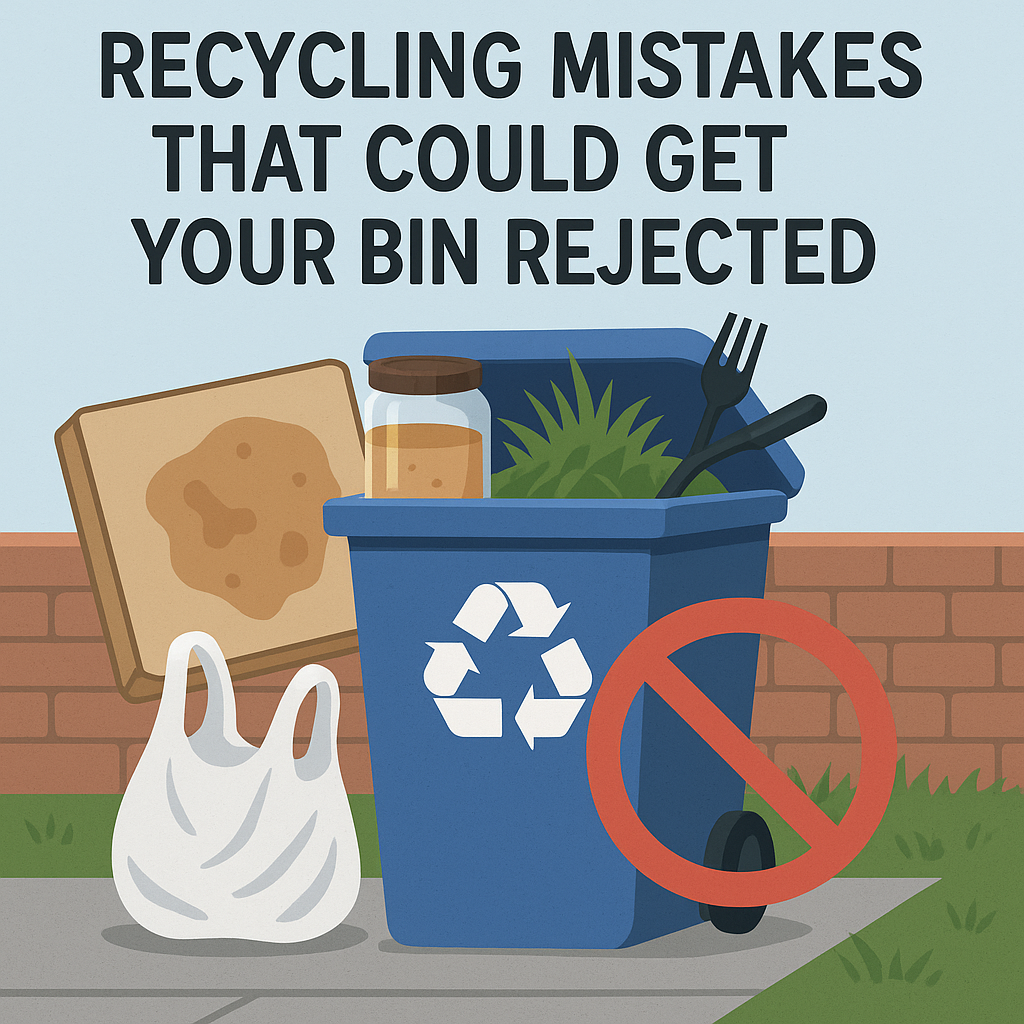
❌ Plastic bags
❌ Styrofoam
❌ Food-soiled containers
❌ Paper towels
❌ Diapers
❌ Tissues
❌ Wipes (even “flushable” ones)
❌ Garden hoses
❌ Textiles
❌ Electronics (usually)
❌ Batteries
❌ Pizza boxes (greasy part)
❌ Broken glass
Putting any of these in your recycling bin can cause:
- The entire bin to be rejected
- Your bin to be flagged
- Future pickups to be monitored
This is covered in:
👉 /recycling-mistakes-that-get-your-bin-rejected
👉 /common-trash-recycling-mistakes-to-avoid
The Most Important Rule in Recycling: CLEAN & DRY
This is a rule most people don’t follow.
Recycling is NOT the same as rinsing dishes perfectly — but items must be:
✅ Empty
✅ Not dripping wet
✅ Not full of food
✅ Not greasy
A single greasy container can ruin an entire load of paper recycling.
That’s why so many recycling loads end up in the landfill even though people “recycled them.”
If it’s dirty and you can’t easily clean it:
➡️ It’s trash.
As painful as that sounds, it’s better than contaminating everything else.
Why Recycling Bins Get Rejected So Often
If your bin wasn’t picked up and you don’t know why:
👉 /what-to-do-if-trash-was-never-picked-up
Most common reasons:
❌ Wrong items in the bin
❌ Mixed trash & recycling
❌ Bagged recycling (plastic bag)
❌ Overfilled bin
❌ Wrong day
❌ Wrong location
And many times, people don’t even realize the mistake.
That’s exactly why your website will help so many people.
Single-Stream vs Dual-Stream: Why It Matters
Some cities use single-stream recycling:
→ Everything goes into one blue bin
Others use dual-stream recycling:
→ Paper & cardboard in one
→ Containers & plastics in another
If you use the wrong system, your recycling is ruined.
Never assume based on another city or a friend’s house.
What About Yard Waste and Compost?
Recycling is NOT the same as composting.
These items should NEVER go in recycling:
- Grass
- Leaves
- Branches
- Food scraps
- Soil
- Flowers
These are handled in a separate system:
👉 /how-to-dispose-of-yard-and-garden-waste
👉 /yard-waste-vs-regular-trash
Mixing yard waste into recycling is a major reason for rejected bins.
A Simple Beginner’s Recycling System (You Can Copy This)
If you want an easy system at home, do this:
Have 2 containers in your kitchen:
🗑️ Trash
- Food waste
- Dirty items
- Plastic bags
- Unsure items
♻️ Recycling
- Paper (clean)
- Cardboard (flattened)
- Plastic #1 & #2 (clean)
- Metal cans
- Glass bottles & jars (clean)
Then once a week, take recycling to your big bin outside.
That’s it. That simple.
By doing this, you’re already better than 90% of the population.
How Proper Recycling Reduces Your Trash by 30–50%
Once you recycle properly, something crazy happens:
Your trash gets lighter.
Your bin doesn’t overflow.
Your house smells better.
You feel more organized.
This connects perfectly with:
👉 /how-to-reduce-household-trash-by-50
👉 /how-often-is-trash-collected-us
Especially if you’re in a bi-weekly trash area, proper recycling is essential for not overflowing your bin.
What If You’re Still Not Sure About Something?
When in doubt, you should:
- Check the symbol:
👉 /recycling-symbols-explained - Check your local rules:
👉 /complete-guide-trash-recycling-pickup-us-cities - If still unsure:
➡️ Put it in trash (not recycling)
Because one wrong item is worse than one missed recycled item.
Final Thoughts
Recycling isn’t about being perfect.
It’s about being informed.
Once you understand the basics, it becomes almost automatic:
✅ You see an item
✅ You recognize the material
✅ You know where it belongs